How to Manage Your Time Effectively: The Eisenhower Matrix and the 2-Minute Rule
Effective time management means choosing the right work first and only then working faster: sort tasks with the four-box Eisenhower matrix, do anything that takes under 2 minutes right away, and keep just 3 main tasks per week so you still have energy for yourself at the end of the day. This post gives you a compact practice framework you can start today.
Effective time management starts with choosing the right work before working faster
Many people think time management means squeezing as many tasks as possible into one day. I think the opposite: time management is deciding which tasks are allowed to take up space in your day. According to Wikipedia, time management is the process of planning and controlling how much time is spent on specific activities, so that you work more effectively rather than simply staying busier.
When everything is “important” and “urgent”, you run from one task to the next and still feel at the end of the day that you have done nothing for what you truly want. A familiar sign is feeling busy all day yet empty, or always answering messages quickly while the important piece of work waits until night. The cause is usually a missing filtering step before you begin, and you are not lazy at all.
So my practice framework has 3 layers, in this order: (1) filter tasks with the Eisenhower matrix, (2) clear small tasks with the 2-minute rule, (3) lock your calendar with 3 main tasks each week. To make it easy to remember, I call it the Filter – Clear – Lock Framework.
| Layer | Question to answer | Time per day |
|---|---|---|
| Filter (Eisenhower) | Which tasks are important, and which are only urgent? | 5 minutes in the morning |
| Clear (2 minutes) | Which tasks can be finished in under 2 minutes? | One 10–15 minute round |
| Lock (3 main tasks) | Which 3 tasks cannot slip this week? | 10 minutes at the start of the week |
Effective time management at work: the Eisenhower matrix and the 2-minute rule
The Eisenhower matrix sorts tasks along two axes: important and urgent. It is associated with the name of former US president Dwight Eisenhower and became widely known through Stephen Covey's book on the seven habits. All you need is a sheet of paper divided into 4 boxes: write down everything you can think of, then place each task in the right box.
- Box 1 – Important and urgent: do it today (a tight deadline, something that cannot be moved).
- Box 2 – Important but not urgent: schedule it at a specific time. This is the box for long-term growth, such as learning a skill, exercise, writing and caring for relationships.
- Box 3 – Urgent but not important: ask someone else, batch your replies into one round, or politely decline.
- Box 4 – Not important, not urgent: drop it, or save it for rest you choose on purpose.
What I like most about this matrix is that it makes you notice that box 2 keeps getting pushed back. The things that truly change your life are rarely urgent, so if you do not schedule them, boxes 1 and 3 will swallow your whole day.

The 2-minute rule: clear small tasks before they pile up
The 2-minute rule comes from David Allen's Getting Things Done method: if a task takes under 2 minutes, do it right away instead of adding it to a list. The reason is simple: writing a small task down and remembering it later costs more time than just doing it. Replying to a message, filing a piece of paper and booking an appointment are typical examples.
One caution: do not let this rule become an excuse to scroll through messages all morning. I often suggest batching 2-minute tasks into one 10–15 minute round at the time of day when your energy is lowest (usually early afternoon), so your best hours go to the work in box 2.
| Do | Avoid (common mistakes) |
|---|---|
| Pick at most 3 main tasks for a day. | Write a list of 15 tasks and feel like a failure by 5 p.m. |
| Set a specific time for the work in box 2. | Only write “will do when free”, and free time never comes. |
| Leave 1–2 empty slots each day for things that come up. | Fill the schedule minute by minute, then blame yourself when one task runs late. |
| Allow yourself to cross out box 4 tasks completely. | Keeping every task “just in case” leaves your list overloaded all the time. |
Effective time management for studying and for students: the weekly plan with 3 main tasks
For school and university students, the challenge is usually too many things at once: assignments, exam subjects, extracurriculars and part-time work. I find the gentlest way is to switch from a daily list to a weekly plan with 3 main tasks: at the start of the week, choose exactly 3 tasks that cannot slip, give each one a fixed time slot, and treat everything else as extra work for when you have energy left.
- Main task 1 – the nearest deadline: an assignment, a report or another item with a specific due date.
- Main task 2 – long-term growth: revising a subject, learning a skill, building a habit. This is exactly box 2 of the matrix.
- Main task 3 – one thing for yourself: a walk, enough sleep, meeting a friend. In weeks when you skip this one, you usually run out of energy the following week.
At the end of each day, spend 3 minutes looking back: which main tasks are done, and which move to tomorrow. The purpose of looking back is to adjust your time slots to be more realistic, so be gentle with yourself. If you want more discipline, also read building self-discipline and morning habits to build a steady daily rhythm.
15-minute exercise: build your Filter – Clear – Lock Framework for this week
- Step 1 (5 minutes): write down everything on your mind on one sheet of paper, with no need to organize it.
- Step 2 (4 minutes): draw 4 boxes and place each task by importance and urgency. Cross out every task that lands in box 4.
- Step 3 (2 minutes): circle the tasks under 2 minutes and book yourself one clearing round in the early afternoon.
- Step 4 (4 minutes): choose 3 main tasks for the week, write the specific day and time next to each, and keep the sheet where you will see it every morning.
Jennie's perspective: time is how you say “yes” and “no”
I think time management is really the management of “no”. Every time you accept one more unimportant task, you are saying “no” to something important that you cannot see yet. So instead of asking “how can I get more done”, I often suggest asking “what deserves my energy this week”. When the answer is clear, your day lightens by itself, and you have room for both rest and the things you love.
Keeping the rhythm long term with one place to write things down
One reason many people give up after a few days is scattered notes: goals in one notebook, affirmations on a slip of paper, a vision board stuck somewhere. Below are two real stories from the Yinyang Masters community about gathering everything in one place so it is easier to return every day.
Love story: After a breakup she could not let go of
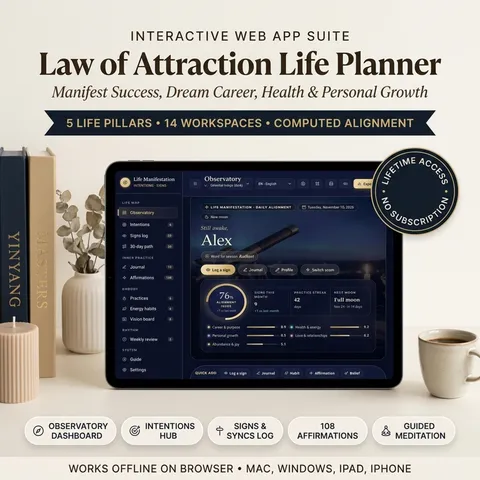
One web app replaces a pile of love notebooks, printed affirmation cards and scattered meditation files: a journal, 108 affirmations, moon rituals, a 30-day path and a guided love meditation all live in one place, opening in the browser on your phone or laptop.
- Set 1 love intention (self-love, calling in a soulmate, healing after a breakup or twin flame connection) and gather all your practice around it.
- Read and count 108 love affirmations, and do rituals for the new moon, the full moon and each day of the week.
- Follow a 30-day path that tells you what to do today, with a guided love meditation of about 13 minutes.
Money story: Paying off the card she had been avoiding
One web app replaces many money notebooks, affirmation lists and meditation files: goals, a wall of evidence, 108 money affirmations, moon rituals and a guided abundance meditation all sit in one place, opening in the browser on your phone or laptop.
- Read along with 108 money affirmations and work through the part that unties money knots to rewrite old beliefs.
- Do rituals by moon phase and listen to the guided abundance meditation on any device.
For more than 8 years, a community of over 2.4 million followers and 38,000+ students has shared real results from keeping up these practices in love, finances and inner peace. Using it is simple: open it in any browser on a computer, tablet or phone. No account needed. Write your first entry, then come back every day. Everything is saved right on your device.
Why use a digital journal instead of a stack of notebooks
Practice is often scattered everywhere: one notebook for affirmations, another for scripts, a vision board on the wall and meditation tracks somewhere on your phone. A digital journal gathers everything into one modern web app, so practice stays tidy and easy to return to.
You open it in the browser on your phone, computer or tablet, with nothing to install and no need to install an app, and it also works without internet. Everything you write stays private on your device, and you can back it up, restore it in Settings or print any page.
| Paper notebooks and scattered meditation tracks | Web app | |
|---|---|---|
| Affirmations, rituals, scripts, vision board | Scattered across several notebooks and the wall | Many linked pages in one place |
| Guided meditation | A separate app or a file saved elsewhere | Plays right inside the journal |
| Progress | Counted by hand | Counters, streaks and the path calculated for you |
| Carrying it | Heavy and easy to forget | On the phone, computer or tablet you already use |
| Privacy | Can be lost or read by someone else | Stored on your device, with backup and restore |
To pick more practices for your morning, I suggest reading boosting work performance with just 3 habits and activating maximum focus.
Which box of the 4-box matrix pulls you in the most: the urgent but unimportant box, or the important box that never becomes urgent? Share in the comments so everyone can learn from each other.