How to Read a Natal Chart: 3 Core Elements to Start With
How to read a natal chart for beginners is straightforward: prepare your exact birth date, time, and location, generate your natal chart using a free online tool, and focus on the first three core elements: your Sun sign, Moon sign, and Ascendant. This guide provides step-by-step instructions, a 15-minute journaling exercise, and a clear reminder that astrology serves as a reflective self-discovery tool rather than a fixed verdict.
How to Read a Natal Chart: 3 Core Elements to Read First
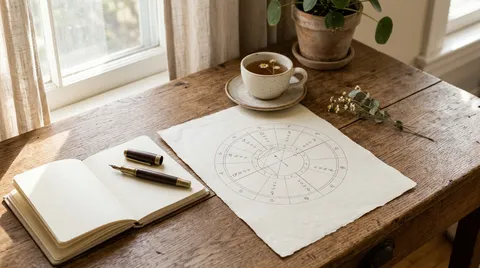
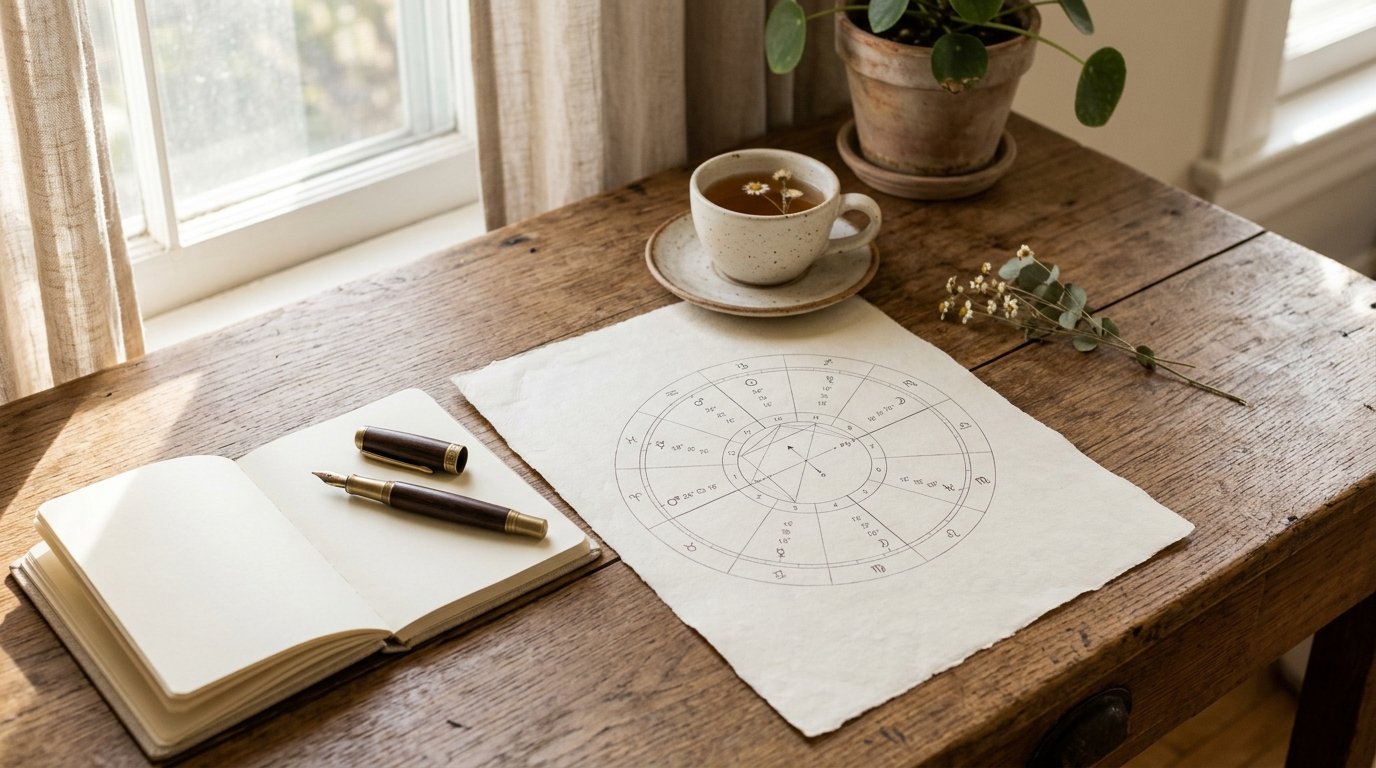
A natal chart (birth chart or astrological horoscope) is a circular map showing the celestial positions of planets at the exact moment and location of your birth. As documented in encyclopedia references, this chart divides the celestial sphere into twelve zodiac signs and twelve houses, placing celestial bodies within them.
When looking at it for the first time, the abundance of astrological symbols can feel overwhelming, so I recommend not trying to decipher everything at once. Begin with three core elements, which together offer a comprehensive initial portrait of your inner landscape.
| Element | What It Reveals | Reflective Journal Prompts |
|---|---|---|
| Sun Sign (Primary Zodiac Sign) | Core identity, life purpose, and authentic self-expression | Who do I truly aspire to become as a conscious person? |
| Moon Sign | Emotional world, intuitive nature, and psychological security needs | What practices provide me with genuine emotional comfort? |
| Ascendant (Rising Sign) | Outward persona, social interface, and initial impressions | What energy do others observe when first encountering me? |
For example, an individual with their Sun in one sign, Moon in another, and Ascendant in a third will notice three distinct internal voices that sometimes align harmoniously and sometimes contradict each other. This dynamic serves as a rich source of self-inquiry and mindful exploration.
What to Prepare for a Free Natal Chart Reading
You do not need paid software to generate an accurate baseline chart. Numerous reputable astrological platforms and mobile apps offer free chart calculations. Astrodienst (astro.com) is one recognized portal providing standard calculations. What matters most is the precision of your input data.
- Exact solar calendar birth date. The Moon shifts zodiac signs approximately every two and a half days, so an incorrect day alters the resulting emotional placements.
- Precise time of birth. Obtain this from an official birth certificate or reliable family records. The Ascendant shifts signs roughly every two hours, meaning a variance of twenty minutes can alter your rising sign.
- Exact birthplace. Enter the specific municipality or city so the system calculates geographic coordinates and historical daylight saving time offsets properly.
- Generate the chart using standard house systems (such as Placidus or Whole Sign) suggested by the tool. Beginners do not need complex customization.
- Save your chart as an image or printable document for progressive study.
If your exact birth hour is unavailable, you can still read your Sun and Moon positions with reasonable confidence; however, your Ascendant and house placements remain undetermined until confirmed. Keep this limitation in mind to avoid premature interpretations.
If you enjoy exploring personal archetypes through diverse spiritual lenses, you might also explore our guide on life path number calculation and personal year calculation in numerology for comparative insight.
Once your chart is ready, consider keeping it in your reflective journal. As you return to it over time, subtle patterns become clearer. Feel free to pencil in personal reflections: your self-awareness remains the most valuable outcome.

What Is a Natal Chart and What Does It Consist Of?
A comprehensive natal chart comprises multiple interpretive layers that you can explore progressively:
- Planets: The Sun, Moon, Mercury, Venus, Mars, Jupiter, Saturn, and outer transits. Each celestial body represents a psychological drive; for instance, Venus highlights how you value relationships and harmony.
- Zodiac Signs: Twelve archetypal energies that describe how each planetary drive is colored and expressed.
- Houses: Twelve practical life arenas, encompassing personal identity, resources, communication, family, relationships, and professional vocation.
- Aspects: Geometric angular relationships linking planets, illustrating whether inner drives operate in synergy or dynamic tension.
From an empirical viewpoint, scientific consensus does not recognize astrology as an empirical predictive science, as detailed under historical literature discussing astrology and epistemology. We engage with natal charts as symbolic languages and qualitative inquiry frameworks rather than dogmatic determinants. Never outsource personal autonomy or major life decisions to external horoscopes.
Be mindful of cognitive biases such as the Barnum effect, where generic statements feel intensely personalized. Protect your clarity by comparing descriptions against tangible lived experience and noting where interpretations do not match your authentic reality.
As you progress beyond the Big Three, incorporate one layer at a time: examine Mercury and Mars to understand mental focus and physical drive, then study career and relationship houses. Deliberate, grounded exploration creates lasting wisdom.
How to Understand Retrograde Planets and Monthly Zodiac Transits
Searches around Mars retrograde or monthly zodiac shifts often surge during popular media discussions. Retrograde motion is an apparent optical phenomenon where a planet appears to move backward against background stars due to relative orbital velocities observed from Earth. It does not reflect a physical reversal in planetary orbits.
In contemplative astrology, retrograde seasons symbolize periods intended for inward reflection, integration, and revision rather than hasty outward expansion. View these phases as gentle invitations to pause and realign, remembering that sovereign choice always remains in your hands.
Once comfortable with your natal foundation, you can gently observe current astrological transits moving across your natal houses. A firm understanding of your primary trinity provides the grounded stability needed for all advanced studies.
How to Use Your Natal Chart as an Inquiry Tool
A natal chart functions best as a compass for self-reflection rather than an inescapable script. Notice the constructive questions it inspires: why you require contemplative solitude, or how your external demeanor balances your internal emotional needs. Writing down these reflections brings clarity to natural human complexity.
| Helpful Practices | Pitfalls to Avoid |
|---|---|
| Start with your Sun, Moon, and Ascendant signs. | Attempting to analyze every technical glyph at once. |
| Verify birth time through official birth records. | Guessing birth times and placing absolute faith in uncertain rising signs. |
| Test astrological descriptions against your lived daily reality. | Blindly accepting every generic description without reflection. |
| Use archetypes as prompts for personal growth and empathy. | Using zodiac stereotypes to judge others or avoid responsibility. |
| Consult grounded educational references with critical thinking. | Paying for sensationalized predictive claims or fear-based readings. |
15-Minute Journaling Exercise: Integrating Your Big Three
- Minutes 1 to 3: Calculate your natal chart and record your Sun sign, Moon sign, and Ascendant at the top of your journal page.
- Minutes 4 to 8: Write a concise summary of each element in your own words, identifying which qualities resonate and which feel distant.
- Minutes 9 to 12: Respond to the three reflection questions presented in the core elements table, dedicating two to three thoughtful sentences to each.
- Minutes 13 to 15: Formulate one practical, empowering action you will take this week to honor your authentic balance.
Have you explored your natal chart before, and which element brought you the most clarity? Share your reflections with me in the comments below.