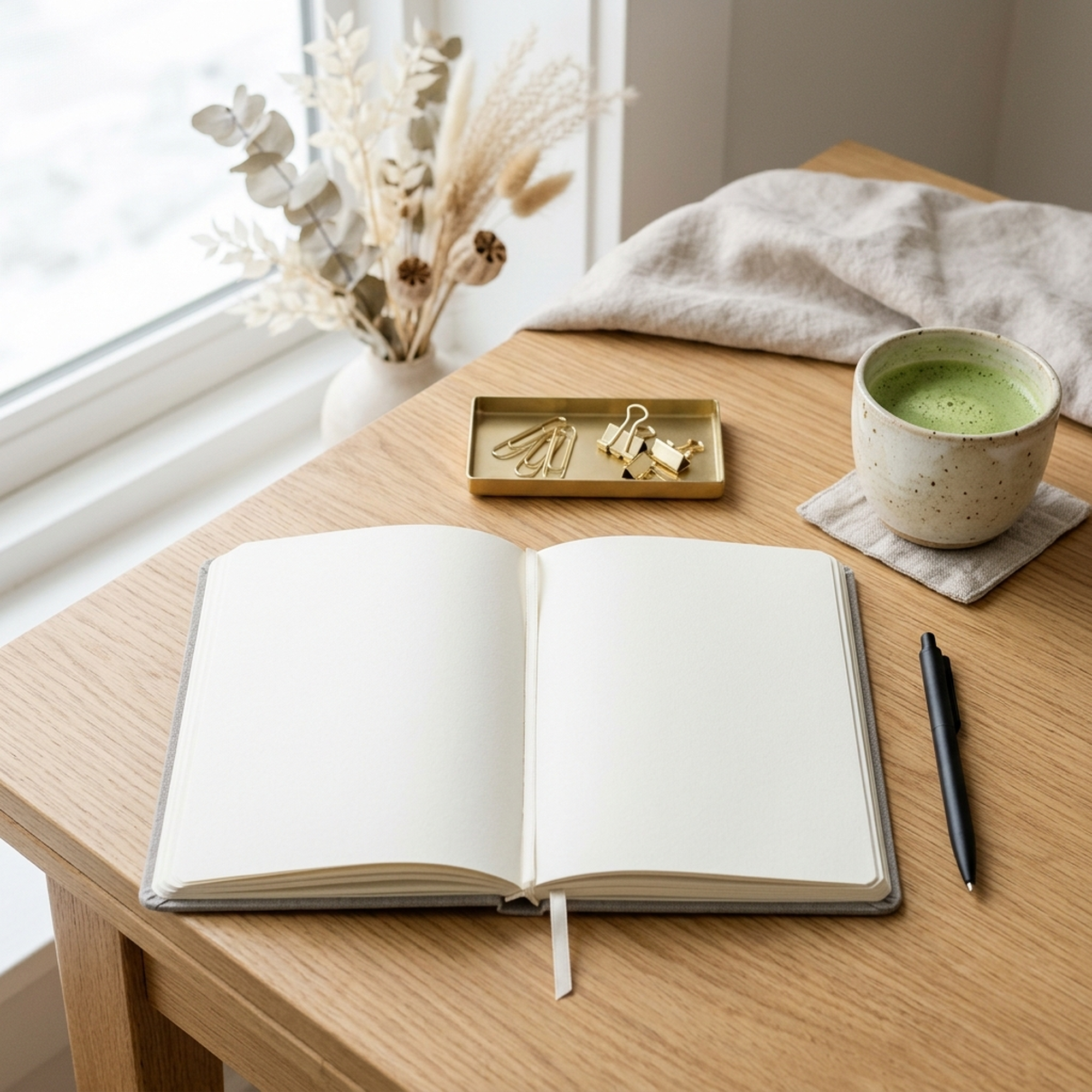
What Is Reflective Writing? Five Practical Notebook Styles for Everyday Calm
Jennie Uyen Chu ·
What Is Reflective Writing? Five Practical Notebook Styles for Everyday Calm
What is reflective writing (journaling)? It is the gentle habit of putting everyday thoughts, emotions, and lingering questions onto paper or a private digital page so you can see clearly what is happening inside. You only need 5 to 15 minutes a day with whatever pen is nearby—polished prose or neat handwriting is never required.
Many readers message me saying they want to write to clear their head, yet the moment they open a notebook they worry their sentences sound clumsy and shut it right back up. I know that feeling well, because years ago I assumed writing belonged only to natural storytellers. Throughout the mindful living journal, I treat a blank page as a quiet, non-judgmental listener—especially helpful if you are reading about what overthinking is and how to quiet looping worries at night.
What Is Reflective Writing and How Does It Differ from a School Diary?
While childhood diaries mostly recapped a schedule—"went to class, rained in the afternoon, ate dinner"—reflective writing takes one deeper step: noticing which feeling an event stirred inside you, which thought keeps repeating, and what practical step makes sense next.
The long tradition of personal diary keeping across centuries served philosophers, artists, and thinkers as a grounded tool for mental clarity. Unlike social media posts shaped by outside eyes, a personal page has only 1 reader: yourself. That private safety lets you name irritation, fatigue, or quiet hope honestly without dressing anything up.
No grades for grammar or spelling: You can jot fragments, bullet notes, or quick arrows linking loose ideas as long as your chest feels lighter.
Aimed at clarity rather than endless venting: Just 8 to 10 honest lines are enough to separate real facts from imagined worst-case stories.
Flexible around busy days: Write on paper beside morning tea or capture quick lines on your phone before bed.
Real Benefits of Spending 5 to 15 Minutes Writing Every Day
When a worry circles inside working memory, your brain spends steady effort keeping it suspended at the front of your mind. The moment you transfer those tangled thoughts onto a page, your brain receives a signal that the details are safely stored and begins releasing physical tension.
Since the 1980s, psychologist James Pennebaker along with broader research on expressive writing and coverage by the American Psychological Association (APA) found that writing honestly about heavy experiences for roughly 15 minutes over several consecutive days helps people organize internal narratives, soften mental strain, and rest more deeply.
In daily life, you will usually notice 3 clear shifts after 2 to 3 steady weeks:
Spotting draining thought loops earlier: Looking back across 10 entries makes it obvious which workplace or family moments repeatedly tighten your shoulders.
Calmer communication under pressure: Instead of sending a sharp reply right away, dumping thoughts onto paper for 5 minutes first lets you choose grounded words.
Deeper self-listening: Many readers share that steady evening entries gradually bring older unspoken needs into focus, echoing themes in healing your inner child with gentle compassion.
5 Practical Notebook Styles for Beginners and How to Pick Yours
People often stop early simply because they tried a format that clashes with their current season. Scan the 5 practical styles below and pick just 1 to test for your first 7 days:
Notebook Style
Simple Method
Best Fit When You
1. Timed Brain Dump
Set a timer for 3 to 15 minutes, empty every racing thought nonstop, and rate heaviness before and after.
Feel mentally crowded, struggle to fall asleep, or feel buried in messages.
2. 4-Step Worry Check
Write the worry, evidence for and against, another perspective, and 1 doable next step.
Replay worst-case scenarios and hesitate over decisions.
3. Gratitude Notebook
Write 3 concrete things warming your morning plus 1 small evening win.
Feel days blending together or notice mostly what went wrong.
4. Prompted Reflection
Pick 1 reflective question each evening and write freely for 5 to 10 lines.
Want deeper self-understanding yet freeze before a blank page.
5. Morning & Evening Check-In
Log morning and evening mood scores plus 3 brief lines on what deserves focus.
Carry a packed schedule with only 3 to 5 spare minutes daily.
If style 3 feels like the gentlest doorway for you, explore how to write a 5-minute morning gratitude journal for ready-to-use starters.
Setting a 5-minute timer and writing without editing lets honest thoughts flow with ease.
How to Write Your First Page Naturally When You Feel Stuck
The biggest hurdle for newcomers is fearing the opening page will look messy or dull. Drop perfectionism right away using 4 simple habits:
Start with 1 ready-made sentence stem: Write immediately: "Right now, the thing taking up the most space in my head is..." and let your hand keep moving for 5 lines without crossing anything out.
Cap your first week at 3 to 5 minutes: Short sessions feel approachable and repeat far more easily than forcing 3 full pages at once.
Rate mental heaviness from 1 to 10 before and after: Watching that number dip from 8 to 5 after a 10-minute brain dump gives genuine motivation to return tomorrow.
Protect complete privacy: Whether using paper or a phone app, knowing nobody else will peek inside unlocks your truest lines.
3 Simple Questions to Start Writing Tonight
Ten minutes before turning off the lamp tonight, choose just 1 of these 3 prompts: (1) What lightened my chest even slightly today? (2) Which worry am I magnifying beyond the facts, and what does the actual evidence say? (3) What is 1 manageable step tomorrow morning that will ease my mind about this?
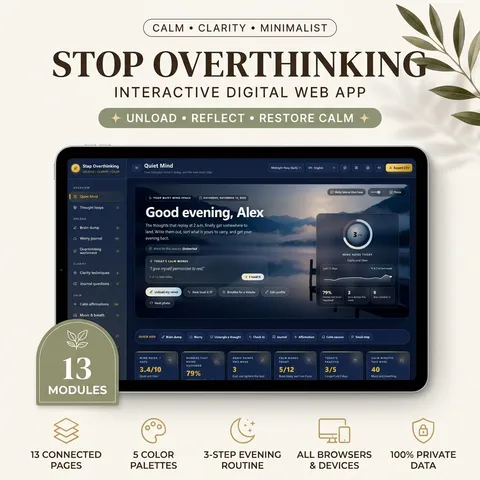
Whenever racing thoughts keep you awake and you want a private phone or laptop space to empty your mind with a 3 to 15 minute timed brain dump rating heaviness before and after, guide each worry through 4 calm steps (the worry, evidence for and against, another view, and 1 doable step), track repeating thought loops, check in morning and evening on a daily chart, and play calm 432 or 528 Hz music, explore the Stop Overthinking Journal.
Skip waiting for the perfect notebook—grab the nearest sheet of paper tonight, set a 5-minute timer, and write 3 honest lines just for yourself.
Jennie has no separate AI assistant on Claude or ChatGPT; her Yin Yang Masters app is listed there — birth charts, numerology and lucky dates right in the chat.
Little Assistant is Jennie's helper. Every hour she writes a diary note about new posts and videos, plus a calm 3-minute practice. Come say hi at her desk.