How to Keep an Intention Notebook with Clear Daily Scripting Habits
Jennie Uyen Chu ·
How to Keep an Intention Notebook with Clear Daily Scripting Habits
An intention notebook is a dedicated journal for writing clear present-tense goals paired with honest gratitude and small practical steps so your mind stays oriented toward what matters. Once you build a calm 5-minute daily scripting rhythm, vague wishes turn into steady mental anchors without pressure or perfectionism.
Many people buy a lovely clothbound notebook, fill three enthusiastic pages on Sunday evening, and leave it forgotten at the bottom of their bag by Wednesday. I know that quiet disappointment well because I abandoned several notebooks in my early years of practice. Usually the friction came from writing far too much, juggling five major dreams at once, and pressuring myself to sound poetic on every line.
How an Intention Notebook Brings Scattered Desires Into One Clear Focus
Across a busy day filled with messages, bills, and errands, personal priorities easily sink beneath routine noise. A dedicated intention notebook gives you a quiet space to gather scattered thoughts around one clear direction. Putting words on paper in your own handwriting naturally slows your mind enough to name what you genuinely want.
From a behavioral psychology lens, this habit draws on two well-studied mechanisms. First, expressive writing on paper clears mental clutter so you can tell which desires come from your own heart rather than comparison with others. Second, implementation intentions sharpen your awareness: when you spell out a clear outcome and context, your brain notices helpful conversations, openings, and small practical steps far more readily.
Turns vague wishes into clear pictures: Instead of casually hoping for a "better life," the page invites you to name the income stability, work rhythm, or warm home atmosphere you are building.
Preserves quiet proof of growth month by month: Flipping back 30 days reveals subtle shifts that a busy memory easily overlooks.
Creates a peaceful pause in your day: Spending 5 unhurried minutes with pen and paper in the morning or evening calms your nervous system before opening or closing the day.
A 5-Step Daily Scripting Routine You Can Finish in 5 Minutes
Any comfortable cream-paper notebook works well—an A5 size fits neatly beside your bed or on a desk—paired with a smooth pen. Once ready, build your daily scripting habit through these 5 simple steps:
Step 1 — Open with 1 minute of grounded gratitude: Before writing what you hope to welcome, jot down 2 or 3 good details already present today. Much like a daily gratitude journal, this shifts your mood from scarcity toward steadiness. You can pair it with our guide to 5-minute morning gratitude journaling for a warm emotional foundation.
Step 2 — Choose 1 priority intention for your current cycle: Pick the goal that feels most meaningful over the next 30 days, such as building a 30 million VND safety fund over 6 months, landing your first freelance design project, or protecting calm family dinners each evening.
Step 3 — Write in the present tense with honest, positive wording: Begin with "I am grateful that..." or "I am glad to..." and avoid negative phrasing like "no longer broke" or "done feeling lonely." For example: "I am grateful that each month I save steadily and feel calm in work that creates real value."
Step 4 — Add a short 5-senses scene: Write 3 to 5 sentences picturing a quiet moment once that goal has arrived: where you are sitting, what cup of tea is beside you, what sounds fill the room, and how ease feels in your chest.
Step 5 — Close with 1 doable step within 24 hours: Beneath every page, add one brief line naming a concrete move you will take today, such as sending 2 portfolio introductions or updating your personal work showcase.
Even a few slow, attentive evening lines plant a far deeper intention than pages written in a rush.
How to Check Whether Your Intention Feels Believable
At the end of each week, reread your intention and rate your certainty on a 1 to 10 scale. If your score sits below 5 because the target feels too distant and stirs tension in your stomach, adjust the milestone slightly until it feels both exciting and genuinely reachable. Calm trust always outlasts forced hype.
Comparing the 4 Most Popular Daily Scripting Methods
Once your pen habit feels natural, you can try different scripting structures to see which suits your temperament and schedule. For a closer look at morning, noon, and evening repetition, read our full 3-6-9 writing method walkthrough. The table below compares 4 classic formats:
Scripting Method
Daily Writing Cadence
Suggested Cycle
Best Suited For
3-6-9 Technique
Write 3 times morning, 6 times midday, and 9 times evening using 1 short line.
21 to 33 days
Busy readers who want light attention anchors across the day in under 10 minutes.
33x3 Technique
Write 33 consecutive lines during 1 quiet sitting.
3 consecutive days
Readers seeking focused short-sprint clarity ahead of an upcoming milestone.
55x5 Technique
Write 55 consecutive lines at one set time each day.
5 consecutive days
People who enjoy deep handwriting with 15 to 20 calm evening minutes available.
Living in the End
Write 1 diary entry of 5 to 10 sentences describing a day after the goal arrives.
30 days
Visual storytellers who grow bored repeating one identical sentence.
Staying Consistent Long Term and 4 Misconceptions That Cause Burnout
Keeping your notebook alive across many months comes down to kindness toward yourself. Rather than demanding two neat handwritten pages every single day, allow yourself 3 simple lines on late nights. Showing up gently matters far more than page length.
Four Common Misconceptions That Stall Your Practice
Treating the notebook as magic that replaces real action: Writing clarifies direction and steadies your heart, while real outcomes unfold as you step forward to meet daily opportunities.
Quitting the whole cycle after missing 1 evening: Busy days happen to everyone. Simply open the next page tomorrow with a light heart instead of scolding yourself and shelving the notebook.
Switching intentions every few days: Constantly changing topics splits your attention. Commit at least 21 days to one clear goal before reassessing.
Forcing cheerful lines while ignoring nagging doubts: When a skeptical voice keeps resurfacing, turn to the back page, write the worry honestly, and rewrite it into a fair, grounded perspective.
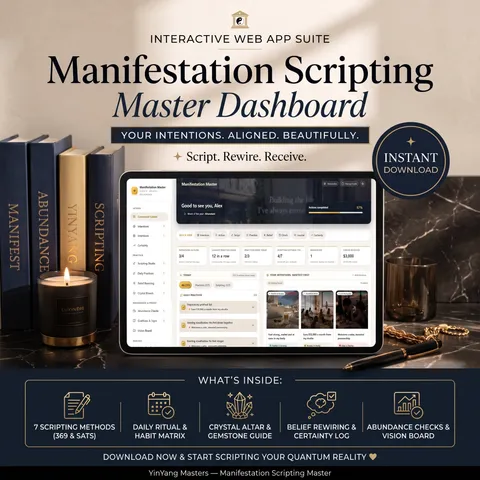
When you want every intention, script, belief-rewriting page, vision picture, and a 2027 moon calendar organized in one private workspace across phone or laptop, explore Manifestation Scripting Master. It offers 7 scripting methods (3-6-9, 33x3, 55x5, 777, Lucky 13, 11:11, and living in the end) with a cycle bar so you finish what you start, plus a weekly 1 to 10 certainty score to watch whether your belief is growing.
Tonight, open a blank page, jot down three small things you appreciate, and write one honest intention for this month. Starting that gently is already enough to open a clearer chapter.
Jennie has no separate AI assistant on Claude or ChatGPT; her Yin Yang Masters app is listed there — birth charts, numerology and lucky dates right in the chat.
Little Assistant is Jennie's helper. Every hour she writes a diary note about new posts and videos, plus a calm 3-minute practice. Come say hi at her desk.